Choosing the Right Chain Hoist for Your Business
A simple guide from Silvie’s Industrial Solutions
A chain hoist helps you lift and lower heavy loads, such as engines, machinery and materials. Choosing the right one depends on what you are lifting, how high it must go and how often you will use it.
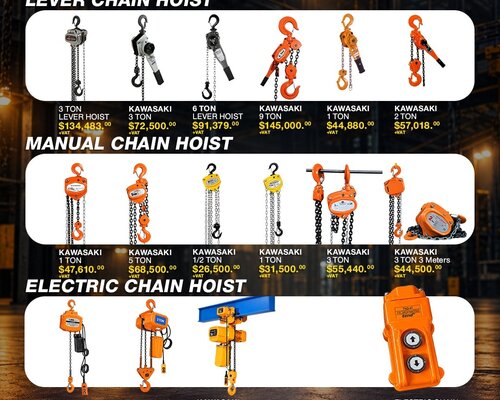
At Silvie’s, we offer manual chain hoists, lever hoists and electric chain hoists.
1. Decide what you need it for
Before shopping, answer these questions:
- What will you lift?
- How much does the complete load weigh?
- How high do you need to lift it?
- Where will you use the hoist?
- Will you use it occasionally or throughout the day?
- Do you need lifting, pulling or positioning?
Your answers will help you narrow down the options.
2. Choose the right type
|
Type |
How it works |
When to consider it |
|
Manual chain hoist |
You pull a hand chain to raise or lower the load. No electricity is needed. |
Occasional lifting in workshops, garages and maintenance areas. |
|
Lever hoist |
You operate a ratcheting handle to move the load. |
Lifting, pulling or positioning, where permitted by the model’s instructions. |
|
Electric chain hoist |
A motor raises and lowers the load. |
Repeated lifting with less manual effort. It must be rated for your workload. |
Always follow the model’s instructions. Pulling applications must keep the hoist and hooks correctly aligned.
3. Check the weight capacity
Know the total weight you will lift, including any lifting attachments supported by the hoist.
Never exceed the hoist’s rated capacity. Check the rating plate and manual to confirm whether the limit is shown in kilograms, metric tonnes or another ton unit.
4. Measure your available space
Check both:
- Lifting height: How far the load hook needs to travel.
- Headroom: The space the hoist occupies between its support and the hook when fully raised.
Enough chain length does not always mean enough room beneath a low beam. For manual hoists, make sure the operator can comfortably reach the hand chain.
5. Consider how often you will use it
Tell the supplier how heavy your usual loads are and how many lifts you expect to make each hour.
For electric models, check how long the hoist can operate and what rest periods it needs. A hoist may handle the weight but still be unsuitable for continuous use.
6. Check the installation
Have a qualified person confirm that the beam, trolley, clamp and supporting structure can safely support the complete lifting arrangement.
For electric hoists, also confirm that your power supply matches the model’s requirements.
Tell the supplier if the hoist will be used outdoors, around chemicals or in food-processing areas. Locations with combustible gases or dust need specially assessed equipment.
7. Plan for safe use and maintenance
Before buying, ask about inspections, servicing and replacement parts.
Make sure operators know how to attach and handle loads correctly. Never use a hoist to lift people, and never stand or allow anyone beneath a suspended load.
Need help choosing?
Send Silvie’s these five details:
- Maximum load weight
- Required lifting height
- Available headroom
- How often you will use it
- Power supply details, if choosing an electric model
Our team can help you compare the options for your business.
Shop online at www.silviesonline.com
WhatsApp: 623-7755 / 705-9309
Georgetown: 31 High & Hadfield Street
Essequibo: Lot 90 East Henrietta