

How to Choose the Right Generator
A Guide from Silvie’s Industrial Solutions
1. Identify what you need to power
-
-
List the appliances, tools or equipment you plan to use.
-
Decide which items must operate at the same time.
-
Prioritise essential equipment during an outage.
-
-
Check running watts and starting watts
-
Running watts keep equipment operating.
-
Starting watts cover the extra power some motors need to start.
-
Refrigerators, pumps and compressors may need higher starting power.
-
Choose a generator that can handle both demands.
-
-
Check the generator’s rated output
-
Compare its continuous output with your running power needs.
-
Check its maximum output against the expected starting demand.
-
Avoid choosing based only on the largest wattage advertised.
-
-
Match your equipment’s electrical requirements
-
Confirm the voltage, frequency and phase.
-
Check that suitable outlets and connections are available.
-
Share photographs of equipment labels when asking for assistance.
-
-
Consider an inverter generator
-
Ask about power quality when using electronics.
-
Inverter models can offer quieter operation and better fuel efficiency at lighter loads.
-
Compare the specifications of each model.
-
-
Choose a suitable starting system
-
Pull-start models use a recoil cord.
-
Key-start models offer electric starting.
-
Electric-start models require a maintained starting battery.
-
Choose a system you can operate comfortably.
-
-
Compare runtime and fuel requirements
-
Check the fuel type required.
-
Compare runtime at the same stated load.
-
Consider how many hours you expect to use the generator.
-
Follow the manufacturer’s fuel and maintenance instructions.
-
-
Consider portability and servicing
-
Check the generator’s weight and dimensions.
-
Look for wheels and handles if you need to move it regularly.
-
Ask about servicing and replacement parts.
-
Plan a suitable storage location.
-
-
Plan for safe operation
-
Operate portable generators outdoors.
-
Keep them at least 20 feet, approximately 6 metres, from doors, windows and vents.
-
Never operate them inside a home, garage or enclosed workspace.
-
Use battery-operated or battery-backup carbon monoxide alarms indoors.
-
Never plug a generator into a wall outlet to power a building.
-
Have a qualified electrician arrange a suitable transfer-switch connection for building circuits.
-
-
Get help choosing at Silvie’s
-
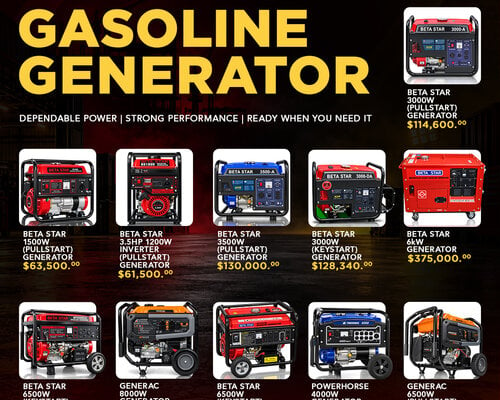
Compare gasoline, inverter, pull-start and key-start options.
-
Send us your equipment list and specifications for assistance.
-
Shop online: www.silviesonline.com
-
WhatsApp: 623-7755 / 705-9309
-
Georgetown: 31 High & Hadfield Streets | 227-6243
-
Essequibo: Lot 90 East Henrietta, Essequibo Coast | 624-5121
/