

How to Choose the Right Water Pump
A Buying Guide from Silvie’s Industrial Solutions
-
Start with the job
-
Identify what you need the pump to do:
-
Fill a storage tank.
-
Irrigate crops.
-
Supply sprinklers.
-
Drain a flooded area.
-
Move water around a worksite.
-
-
Choose a pump designed for that application.
-
-
Check the water condition
-
Is the water clean, muddy or carrying debris?
-
General-purpose pumps suit water-transfer tasks within their specifications.
-
Trash pumps handle solids within their permitted size limits.
-
High-pressure pumps suit jobs requiring greater delivery pressure.
-
Submersible pumps operate in the water, with suitable applications depending on the model.
-
Check the permitted debris size before purchasing.
-
-
Work out how much water you need to move
-
Flow rate describes how much water a pump delivers over time.
-
It is usually measured in litres per minute or gallons per minute.
-
Example: filling a 1,000-litre tank in 10 minutes requires an average flow of 100 litres per minute.
-
Actual delivery depends on your pumping height, hoses and installation.
-
-
Measure the height and hose distance
-
Measure the vertical distance from the water surface to the pump.
-
Measure the delivery height and the full hose length.
-
Include bends, fittings and any pressure needed at the outlet.
-
Ask how much water the pump will deliver under those conditions.
-
Maximum flow and maximum head are different limits—you should not expect both at once.
-
-
Understand the pump’s connection size
-
A description such as “2-inch pump” usually refers to its inlet or outlet connection size.
-
Use this measurement to match hoses and fittings.
-
Pumps with the same connection size can deliver different flow rates and pressures.
-
Compare the complete specifications, rather than connection size alone.
-
-
Choose a suitable power source
-
Consider whether electricity is available where you will work.
-
For electric pumps, confirm the required voltage, frequency and power supply.
-
For gasoline or diesel pumps, compare:
-
Fuel requirements.
-
Starting method.
-
Expected operating hours.
-
Maintenance needs.
-
-
Check the weight, handles and ease of transport.
-
-
Include the correct accessories
-
Ask which suction hose and discharge hose the pump requires.
-
Confirm the correct fittings, clamps and strainer.
-
Use a suction hose designed to resist collapsing under suction.
-
Include these accessories in your budget.
-
-
Check priming and maintenance requirements
-
Follow the model’s priming instructions before starting.
-
“Self-priming” does not necessarily mean the pump can start with an empty pump chamber.
-
Avoid running a pump dry unless the manufacturer specifically permits it.
-
Check servicing requirements and replacement-part availability.
-
-
Send Silvie’s your requirements
-
What will you use the pump for?
-
Does the water contain mud or debris?
-
How much water must you move, and how quickly?
-
What are the suction height, delivery height and hose length?
-
Do you need pressure for sprinklers or another application?
-
Which power source is available?
-
How often will you use the pump?
-
-
Find a suitable pump at Silvie’s
-
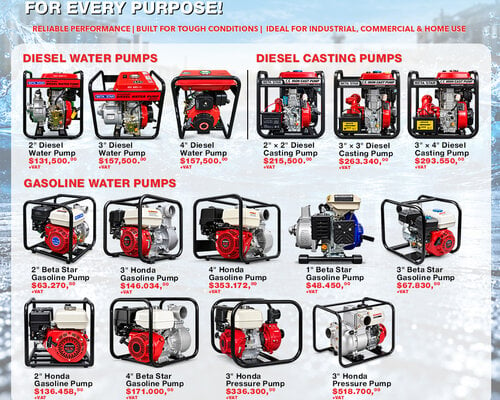
Explore gasoline, diesel and pressure-pump options.
-
Share your requirements so our team can help you compare suitable models.
-
Shop online: www.silviesonline.com
-
WhatsApp: 623-7755 / 705-9309
-
Georgetown: 31 High & Hadfield Streets | 227-6243
-
Essequibo: Lot 90 East Henrietta, Essequibo Coast | 624-5121